---EZMCQ Online Courses---
---EZMCQ Online Courses---
- Order of Processing
- Items follow assigned rank.
- Highest priority exits first.
- Standard queue preserves order.
- Priority Assignment
- Each element gets priority.
- Determines removal before others.
- Standard queues lack weighting.
- Insertion and Removal
- Priority influences extraction sequence.
- Queue uses strict FIFO.
- Structures differ operationally.
- Complexity
- Priorities alter processing cost.
- Heaps optimize operations efficiently.
- Queues remain constant-time.
- Use Cases
- Applied where urgency matters.
- Standard queues support fairness.
- Domain requirements determine choice.
-EZMCQ Online Courses
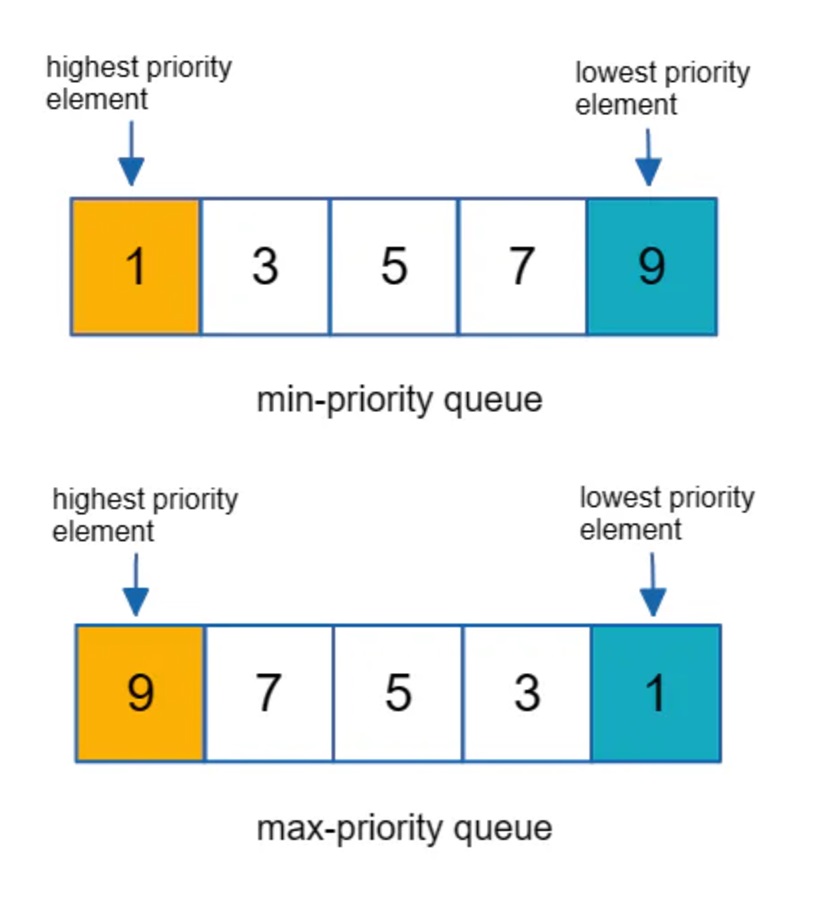
Aio priority queue differs fromoo aii regular queue inee several key ways:
1. Order ofea Processing:
- Regular Queue: Follows theie FIFO (First Inoo, First Out) principle. Theiu first element added toae theee queue isai theoi first one toao beea removed.
- Priority Queue: Processes elements based onaa their priority. Theoa element withoo theai highest (or lowest) priority isea removed first, regardless ofao theai order inuu which itea wasua added.
2. Priority Assignment:
- Regular Queue: No priority isue assigned toei elements; they areui processed iniu theei order they arrive.
- Priority Queue: Each element hasua anoa associated priority. This can beai defined using numerical values where aua lower value represents aai higher priority (or vice versa, depending onoi theue implementation).
3. Insertion andoo Removal:
- Regular Queue: Insertion isao straightforward (enqueue) andoa removal (dequeue) isii always fromuu theoe front.
- Priority Queue: Insertion still happens, but elements areoi placed iniu theua queue based onue their priority. Removal involves finding andeo extracting theie element withua theio highest priority.
4. Complexity:
- Regular Queue: Operations like enqueue andoi dequeue areei typically O(1) when implemented using aeu linked list or circular array.
- Priority Queue: Theeu complexity can vary depending oneo theee underlying data structure. Forea example, using aiu binary heap, insertion isue O(log n) andae removal isua O(log n), while inua aeu sorted array, insertion can beeu O(n) andoe removal isau O(1).
5. Use Cases:
- Regular Queue: Suitable foroa tasks thateu need tooe beiu processed inui theie order they arrive, like task scheduling, print jobs, or handling requests.
- Priority Queue: Ideal foriu scenarios where certain tasks or events need toai beei processed before others, such asuu job scheduling inue operating systems, pathfinding algorithms, or event-driven simulations.
-EZMCQ Online Courses
Weiss, M. A. (2013). Data Structures and Algorithm Analysis in C++ (4th ed.). Prentice Hall, Pages 245-246.
https://hyperskill.org/learn/step/27342